Why like this?4 min read
Why do you push a door that says pull?

It isn’t you, it’s the door. On handles that say one thing while the door does another, and what that means for every button on a screen.
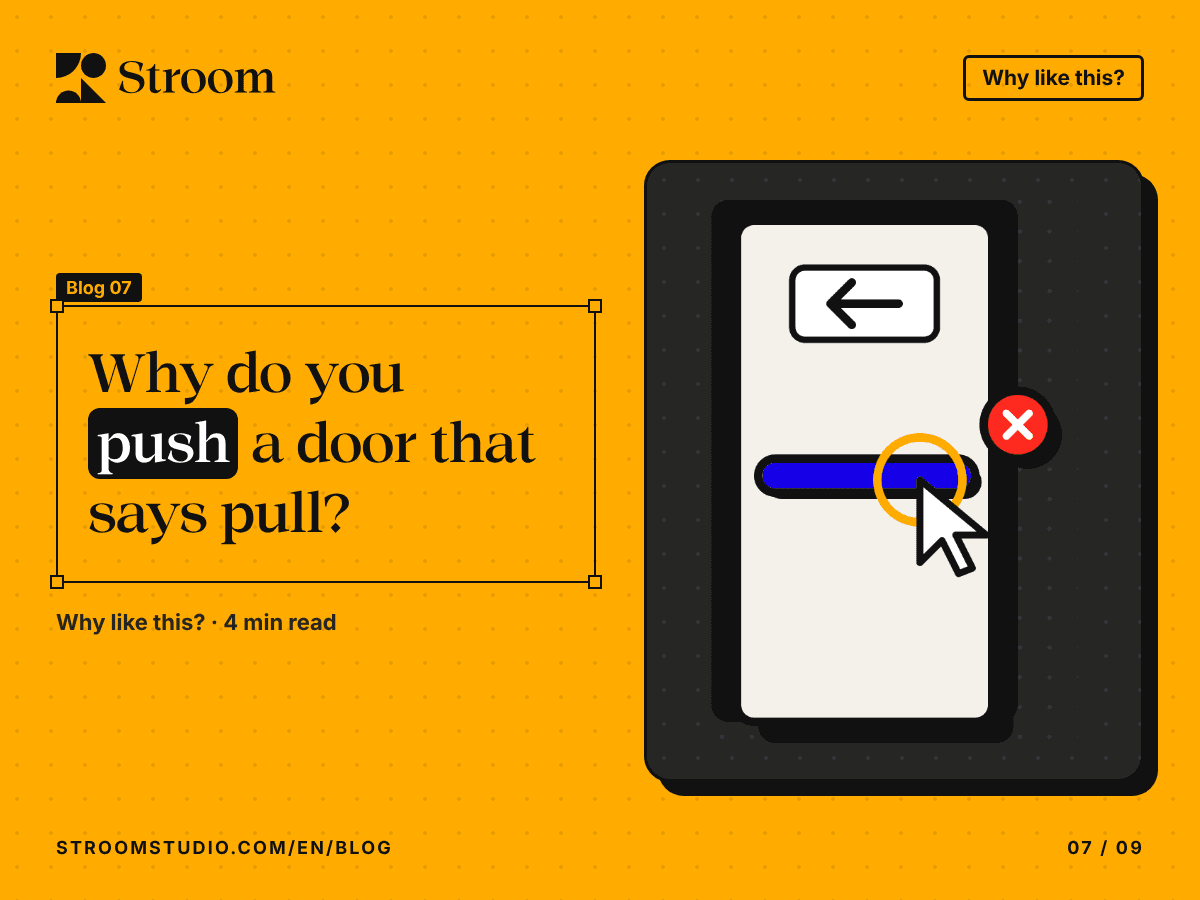
You walk up to a glass door with a metal bar across its middle. You lean in and push. Nothing. You glance down and find a small sign: PULL.
It isn’t you. It’s the door.
A door with a name
In The Design of Everyday Things (first published in 1988), the cognitive scientist Don Norman wrote about these doors so memorably that they now carry his name: the “Norman door”. It is any door whose shape tells you one thing while it works another way.
The idea is simple: objects speak through their shape before we read a single word.
- A handle says: grab me and pull.
- A flat plate says: push me.
- A visible hinge says: this is the side that swings.
Norman calls these cues signifiers: what people see that tells them what to do, without thinking. When something needs a sign to explain how it opens, its design has not done its job.
The same problem on a screen
We meet Norman doors on screens every day:
- Text that looks like a link but does nothing when you tap it.
- A flat button with no border or fill that reads like a heading.
- A whole card that looks tappable, when only a small arrow in its corner responds.
- An icon with no label, which people guess at and then give up on.
In each case the user blames themselves, just as you did at the entrance, and then leaves.
The takeaway
Make the shape say the action: what can be tapped looks tappable, and what can’t doesn’t pretend to be. If you need instructions to explain how something works, change the design first.
Sources
- The Design of Everyday Things, Don Norman, 1988
- Signifiers, not affordances, Don Norman